

“Why we should support recreational cannabis”

Volteface Director Paul North was invited to speak at the St. Andrews debating society on the legal regulation of cannabis in the UK. Speaking in favour of the motion, Paul was joined by Anna Ross, and debated against a House team accompanied by Dr. Lorna Nisbet.
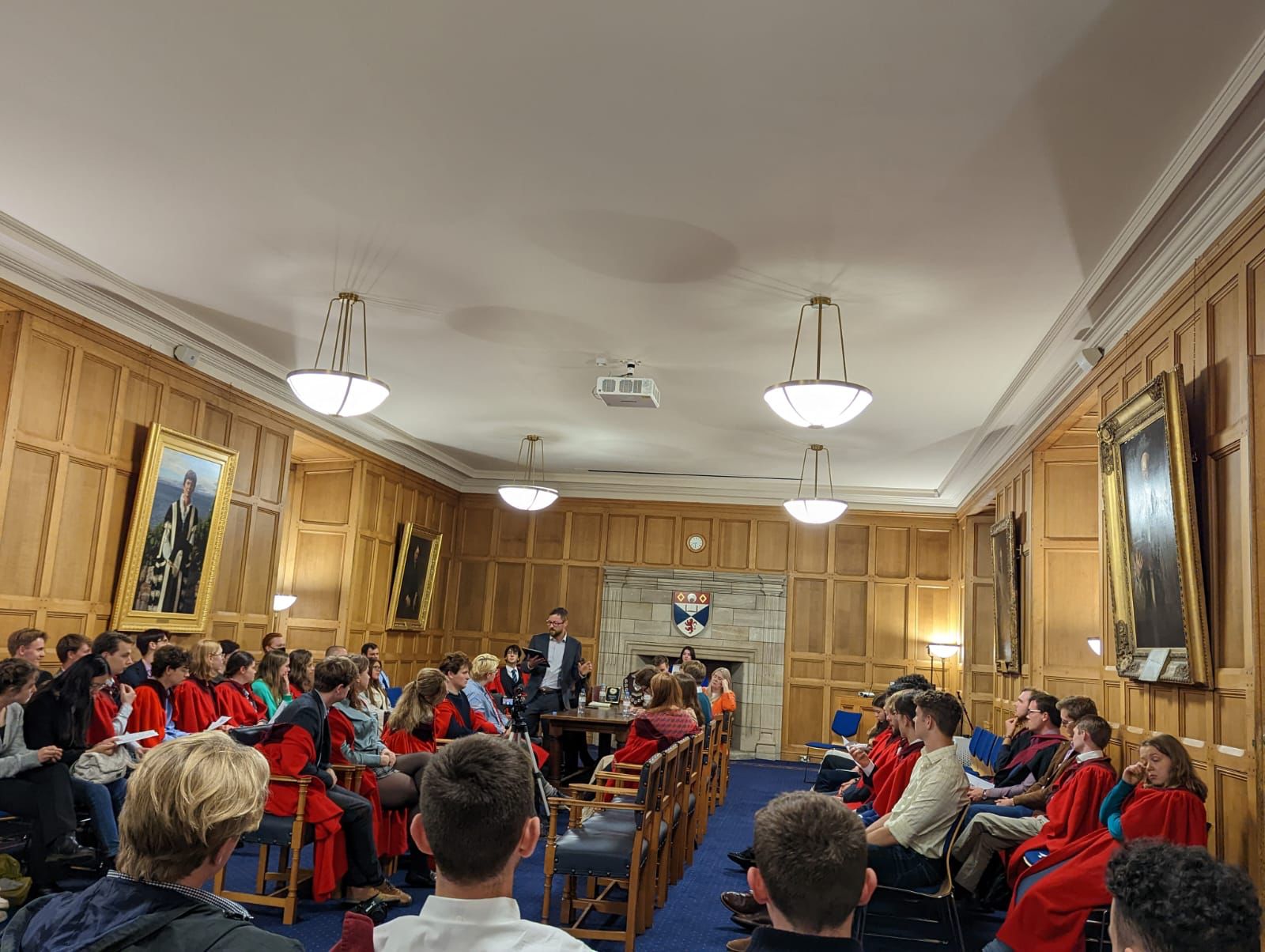
Paul in action at the St. Andrews debating society
You can read Paul’s speech in full below:
“Thank you for the opportunity to speak here today.
I want to begin at a place where I think there will be common consensus in the room, and some of you may even think I am on the wrong debating team.
First of all, cannabis is not without risk and danger. I worked in drug treatment services for over nine years with both young people and adults. While cannabis is not the most harmful drug in society, some people use it problematically and it can have a negative impact on their life.
Secondly I believe that young people should not use cannabis, certainly not with any level of frequency, and although many young people do use the drug up and down the country and in the majority of cases do so without issue, the exceptional ease by which they can access the drug, and strength of the cannabis they use is a problem.
Thirdly, criminal gangs should not be able to make billions of pounds every year from growing and selling cannabis. And furthermore, their exploitation of young people and adults to grow and sell cannabis is a huge issue, and one which we cannot ignore.
It was my frustrations at these realities which led me to the position to support legal, adult use regulated cannabis markets. Because if you want to address those issues, regulation is the only sensible, evidenced based policy solution available.
Right now across the UK cannabis is sold to over 5 million people every week, making gangs billions of pounds in profit. The drug has no regulation, no quality control and no meaningful or effective education intervention in place, all factors which compound and increase harm – particularly to young people.
The illegal cannabis market, just like any other illicit market, has created an increase in purity of the drug. This has flooded the market with high potency cannabis, pushing social trends and preferences for both young people and adults, normalising the strength of the drug.
From my experience of working with problematic cannabis users for over nine years, the most harmful aspect of their use was arrest and criminalisation, a mark on their record which can last years, ruining employment opportunities and careers.
The only way to make cannabis safer is to take it from gangs and put it in the hands of people whom governments can regulate and control it.
Here in the UK young people access cannabis easier than alcohol. I worked in youth offending teams, delivered drug education programmes in schools across the country, and carried out detailed policy research on the issue. Dealers do not ask for ID and happily sell cannabis to young people. It is exceptionally easy for them to access and use the drug.
In Canada where sensible evidenced based regulation of cannabis has been implemented, youth access has started to reduce.
National education programmes have been implemented, informing young people of the risks and advising them that if they want to try cannabis, they should wait until they are an adult. When they choose to try the drug as an adult they are given education and support at point of sale, guiding them on what strains to try and how to consume it. Again, reducing the risks of harm.
Cannabis is a complicated drug. I have seen first hand how it has transformed and changed the lives of people as a medical product. In 2018 we ran a high profile media campaign, showing the UK public the life changing effect medical cannabis was having on Billy Caldwell, reducing 100 life threatening seizures per day to none, overnight with the application of cannabis oil.
But, cannabis does have risks and for some people they experience dependency issues. What must be taken into account here is how illegal markets and prohibition increase the harm significantly.
The lack of education on how to use the plant safely, the unregulated product – grown to be stronger than the competition, the stigma from using an illegal drug reducing the chance of someone seeking help, criminal prosecution – ruining life chances all combine to significantly increase the risk of using the drug.
In many ways the concept of legalising cannabis and creating legal regulated cannabis markets is a thought exercise. Would you rather see a very acute risk of harm among 5 million of the UK’s population, or a very mild risk of harm among around 10 million of the UK’s population. Personally, after seeing the devastation caused by the current system here in the UK and the legal Canadian cannabis market, I would choose the latter.
As we can see from Canada and the US, youth access drops when you bring in regulation. Education increases, and as the product is regulated the risk of negative consequences reduces significantly.
In the UK there are around 1.4 million people who use cannabis for medical purposes and around 5 million who use the drug at least every 3 months. For the overwhelming majority of those cases the drug is grown by criminal gangs, who exploit young people, adults and the sale and production of the drug gives them capital to commit a wide range of dangerous, harmful acts.
We have been fighting a war against drugs in the west for around 75 years and it has failed completely to reduce cannabis use or eliminate criminal gangs. Now around the world governments are realising the futility of the ‘war on drugs’ and instead creating sensible regulation to take power from gangs and put it in an environment which they can control.
Now, I must be clear, there are emerging models across the globe to grow and sell cannabis and none of them are perfect. Some of them have quite serious problems. The US is somewhat of a wild west of cannabis, with a great deal of marketing and few restrictions, Canada has issues around its taxation of the drug and still has an active, although shrinking illicit market.
Yet, every one of these regulated markets is exceptionally superior to what we have here in the UK. In a regulated market you create jobs, economic growth, innovation and global trade.
Three years ago I organised a study trip of UK politicians, policy makers and third sector charities to visit Canada to see their legal adult use cannabis market.
On the trip over I spoke with one politician at length about their concerns: surely everyone will be smoking cannabis, the mental health issues must be skyrocketing, people must be getting lazy and not going into work, there must be huge issues with driving while under the influence?
After three days of speaking to Canadian policy makers, visiting the dispensaries, seeing the cultivation sites, speaking to drug treatment and mental health specialists, the reality was quite different.
In fact, while sitting together in a taxi on the way back to the hotel one day the politicians turned to me and said, ‘It’s actually quite boring isn’t it?’. He was right. The legal regulated market has not resulted in any of his fears and if anything has happened without a huge amount of fuss.
We must also when debating this topic be acutely aware of the misinformation and stigma which exists around cannabis. As I have outlined, cannabis can be harmful. Using without understanding the effects or risks can result in harm.
But as with any debate over a morally contentious issue we must be careful to examine the evidence closely and recognise where we have been influenced by the media and misinformation.
When you peel back the veil, drop the years of engrained societal stigma, look at the evidence, compare cannabis to alcohol and tobacco and go visit a country with a sensible model of regulation, it’s very clear that the only realistic and informed position to take is that we should follow in the footsteps of 12 US states, Canada, Switzerland, Luxembourg, Uruguay, Portugal, the Netherlands and Germany, by supporting the use of recreational cannabis and developing a safe regulated adult use market.”
Want to comment or contribute?
Join the debate on twitter @VolteFaceHub
Leave a Reply
You must be logged in to post a comment.
The week in drugs and drug policy, in one email.
The newsletter opens soon. Follow the RSS feed in the meantime.